
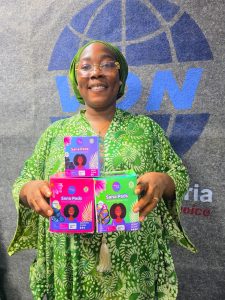
A Nigerian social development practitioner, Mrs Mary Azaki Olowoloba, says reusable menstrual products can help address period poverty among women and girls while reducing the environmental burden associated with disposable sanitary products.
Olowoloba, founder of Sana Pads, made the call in an interview with Voice of Nigeria, saying greater access to affordable menstrual products, clean water and appropriate sanitation facilities was essential to improving menstrual hygiene.
She said her experience with girls in rural communities who had never used sanitary pads because of financial constraints inspired the development of reusable menstrual products.
“We had few young girls who had never seen a sanitary pad before because of rags that they were used to,” she said.
Olowoloba said Sana Pads was developed to provide women with different menstrual-flow needs with a reusable alternative to single-use products.
She said the products were available in light, normal and heavy-flow options, adding that the designs were developed after the company reviewed existing reusable products.
“So we decided to improve from what we saw in the market. We purchased from different vendors who make reusable sanitary pads. Look at what they made. Improve on it. And then we came up with the light flow, normal flow, and the heavy flow,” she said.
Olowoloba said the use of reusable products could also help reduce waste generated by disposable sanitary products, particularly in communities with inadequate waste-management systems.
She said the products were made from locally sourced cotton fabric and subjected to washing and sterilisation processes before production.
“We wash every fabric before we cut them. We wash every fabric with detergent. No bleach,” she said.
She, however, acknowledged that reusable menstrual products require access to water and appropriate hygiene facilities for safe and effective use.
Olowoloba said users were advised to soak used pads in water before washing them with detergent and fresh water.
She said some initial concerns about washing reusable menstrual products had gradually reduced as users became more familiar with their use and maintenance.
The founder identified funding, marketing, regulatory procedures and access to clean water as some of the challenges limiting the wider adoption of reusable menstrual products.
She called for stronger government support for sustainable menstrual-health solutions, particularly through investment in water infrastructure in underserved communities.
“Every community should be able to access good water. It’s the least they can do for us to help this market go forward,” she said.
Olowoloba also called for more streamlined regulatory procedures for manufacturers, arguing that overlapping requirements could increase the difficulty of expanding local production.
“Why do I have to register for NAFDAC and register for SON? Why can’t we have everything in one place?” she asked.
Recent research has identified the cost of menstrual products, inadequate water and sanitation facilities, and limited menstrual-health education among the factors contributing to period poverty in Nigeria.
A 2026 study published in BMC Public Health also found that economic and sociocultural barriers were among the most consistently documented drivers of period poverty in Nigeria, with water, sanitation and hygiene challenges also identified as significant barriers.
Olowoloba said addressing the challenge would require a combination of affordable menstrual products, public awareness, adequate water infrastructure and supportive regulatory policies.
• Continuous Period Equity Wire
Curator’s Note & Original Source
Love Her Period Foundation curates and republishes verified reports, policy milestones, and field updates to elevate national awareness and community action. Read the full investigation and verified reporting directly on the original publisher’s platform.
Take Action in Washington State
Period poverty affects 1 in 4 students and unhoused individuals across the Pacific Northwest. Help us distribute 100% certified organic hygiene care kits directly to schools, shelters, and community hubs.

Menstrual hygiene: Nigerian firm moves against period poverty, introduces reusable sanitary pads
Chairman and Chief Executive Officer of Sana Pads Limited, Mary Sabo Olowoloba Sana Pads Limited, a Nigerian menstrual health company, has intensified efforts to tackle period poverty by producing reusable

Drive 2 Unite revs up fight against period poverty
Hundreds of cars and bikes are set to take over the streets of Johannesburg on September 27 to make an impact against period poverty for Drive 2 Unite, an initiative
Join fun run at Brakpan Airfield to combat period poverty
Families, runners, walkers, aviation enthusiasts and community members are invited to take part in the Empower Her Charity Fun Run on September 24 at the Brakpan Airfield. The event aims