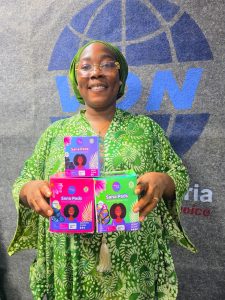
A Cape Town activist whose campaign against period poverty now supports 167 schools has been named an international finalist for the prestigious She Inspires Awards 2026 in the UK.
Lindsay Adams, founder and CEO of #AgainstPeriodPoverty (#APP), is a finalist in the Agent of Change category, taking a campaign that started in Westridge, Mitchells Plain, onto the global stage.
“When I founded #AgainstPeriodPoverty in Westridge, Mitchells Plain, after seeing young girls miss school simply because they couldn’t afford sanitary pads, there was no manual for a global stage,” Adams said.
“There was this reality and an urgent need to protect a child’s right to education.”
From Mitchells Plain to the global stage
She said being recognised as an Agent of Change showed how the organisation had developed from a grassroots initiative into what she described as a systemic movement aimed at restoring dignity, challenging menstrual stigma and advocating for policy change.
The organisation currently provides ongoing menstrual health and hygiene education and sanitary products to schools in Cape Town and towns such as Worcester, Barrydale, Ladismith, Caledon, Malmesbury and Riebeek-Kasteel.
Adams said what she had witnessed through the organisation showed that period poverty was not merely a hygiene issue, but an educational crisis.
“When a family has to choose between buying a loaf of bread or a packet of pads, pads become a luxury,” she said.
According to Adams, some girls resort to using old rags, newspapers and socks when sanitary products are unavailable.
She said the organisation regularly encountered girls who missed several days of school each month because of menstruation, while the embarrassment and anxiety associated with not having sanitary products could also damage their confidence and self-esteem.
Period poverty is an education crisis
“A sanitary pad is far more than a hygiene product. It is a tool for classroom retention,” Adams said.
“We aren’t just handing out resources, we are keeping girls in class, restoring their dignity, and ensuring that a natural biological process never dictates a child’s education.”
Adams said cultural stigma remained one of the biggest barriers, particularly where menstruation was still treated as something secret or shameful.
Her message to young girls experiencing period poverty was that menstruation should never become a source of shame.
“Your period is a sign of health, strength and life. It is not something you should have to apologise for or hide,” she said.
“If you are sitting in a classroom right now feeling anxious, or if you are staying home because you don’t have access to sanitary products, please know that you are not alone, and you have nothing to be embarrassed about.”
The campaign’s next steps
She encouraged girls to approach trusted teachers, friends or organisations for assistance and urged them not to allow period poverty to determine their futures.
For Adams, the international recognition is another step in a much larger campaign.
#APP is introducing student ambassadors in schools to create support networks and encourage open conversations around menstruation. The organisation is also rolling out sanitary pad vending machines aimed at giving learners discreet and immediate access to free products.
Its longer-term push is for menstrual health education to be incorporated into the national school curriculum and for sanitary pads to eventually be provided free of charge across the country as an essential item.
The She Inspires Awards ceremony is scheduled to take place in the UK on November 18, 2026.
Cape Argus