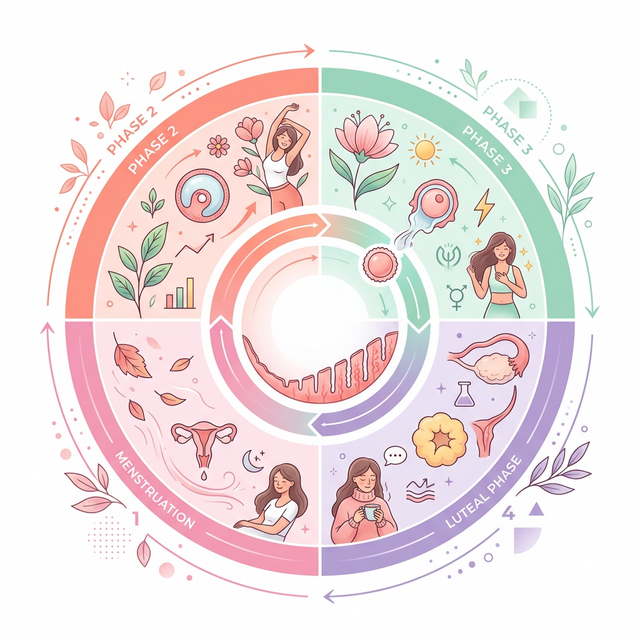
From 9-to-5 workdays to daily morning workout routines, contemporary society is engineered around a 24-hour clock. This schedule mirrors the male hormonal cycle, in which testosterone peaks every morning and declines each evening. But female biology operates on a second, profound biological clock: the 28-day Infradian Rhythm.
What is the Infradian Rhythm?
While the circadian rhythm governs sleep-wake cycles over 24 hours, the infradian rhythm orchestrates biological, neurological, and hormonal fluctuations across four distinct phases of the menstrual cycle. These shifts alter brain neurochemistry, basal metabolic rate, and stress resilience by up to 25% over each month.
The Four Phases of the Infradian Cycle
- Follicular Phase (Days 1–7 post-menses):
- Endocrinology: Estrogen rises steadily as follicles mature.
- Cognitive Profile: Heightened neuroplasticity, creativity, brainstorming, and curiosity.
- Optimal Activity: Initiating new projects, strategic planning, and moderate cardio.
- Ovulatory Phase (Days 14–17):
- Endocrinology: Luteinizing hormone (LH) and estrogen peak simultaneously.
- Cognitive Profile: Verbal communication, executive charisma, negotiation, and collaborative energy.
- Optimal Activity: High-impact presentations, difficult conversations, and high-intensity interval training.
- Luteal Phase (Days 18–28):
- Endocrinology: Progesterone surges, stimulating the uterine lining and raising resting metabolic temperature.
- Cognitive Profile: High detail orientation, administrative focus, organization, and analytical synthesis.
- Optimal Activity: Editing, finalizing contracts, bookkeeping, and restorative strength training.
- Menstrual Phase (Days 1–5):
- Endocrinology: Progesterone and estrogen drop to baseline; right and left brain hemisphere communication peaks across the corpus callosum.
- Cognitive Profile: Intuition, structural reflection, evaluation, and instinctual clarity.
- Optimal Activity: Rest, journaling, gentle walking, and somatic restoration.
Cycle-Syncing as Sovereign Reclamation
When women are taught to ignore their infradian clock and maintain identical output every day, chronic burnout, hormonal imbalance, and dysmenorrhea follow. Understanding your infradian rhythm transforms self-care from a vague consumer slogan into a rigorous, scientifically validated protocol for lifelong vitality.